High and Mighty: Why the Nosebleed Seats Have Become Broadway's New Throne
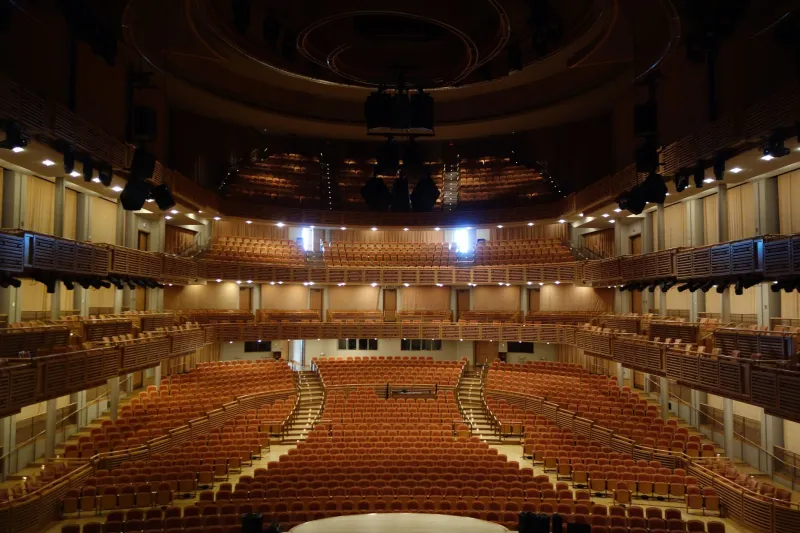
For most of the twentieth century, the upper balcony occupied a peculiar position in the theatrical imagination — simultaneously essential and embarrassing. It was where students, struggling artists, and devoted dreamers perched with binoculars and craned necks, straining to catch a glimpse of the spectacle unfolding far below. The orchestra section, with its plush proximity to the stage, was understood to be the rightful domain of prestige. The balcony was merely tolerated.
That understanding, it turns out, has been quietly and rather dramatically overturned.
Across Broadway and beyond — from the historic houses of Midtown Manhattan to the grand regional theaters of Chicago, Los Angeles, and Washington, D.C. — a significant cultural realignment is underway. The upper balcony, once the theater world's afterthought, has emerged as the unexpected seat of authentic theatrical passion. And for a growing cohort of American theatergoers, sitting farthest from the stage has become not a concession, but a declaration.
The Ascent of the True Believer
The phenomenon defies conventional logic. In an era when premium seating packages command prices that rival fine dining and luxury travel, one might expect the most fervent fans to gravitate toward the front rows. Instead, something more nuanced is occurring. The theatergoers who return to the same production five, ten, or twenty times — who know every lyric, every lighting cue, every subtle shift in blocking — are frequently the ones seated in the final rows of the upper tier.
Part of the explanation is economic. Broadway orchestra seats routinely exceed three hundred dollars, placing repeated attendance beyond the reach of all but the most affluent. The balcony, by contrast, offers access — and in doing so, it has quietly become the engine of theatrical obsession. The person who has seen a production once from the orchestra has a very different relationship to it than the person who has seen it eleven times from the second balcony. Frequency, it turns out, cultivates a depth of engagement that proximity alone cannot manufacture.
But economics tell only part of the story. Among the most devoted segments of contemporary theater culture — particularly the communities that have formed around musical theater fandoms — the balcony has acquired a distinct identity. It is the seat of the zealot, the scholar, the memorizer of cast albums and chronicler of performance variations. To sit in the balcony, in this reading, is to announce one's seriousness of purpose.
The Social Media Coronation
No account of the balcony's cultural rehabilitation would be complete without examining the role of digital platforms in accelerating its transformation. On TikTok, Instagram, and the labyrinthine fan communities of Reddit and Tumblr, balcony culture has developed its own vocabulary, rituals, and aesthetics.
Videos filmed from the upper reaches of Broadway houses — capturing the dizzying vertical drop to the stage, the sweep of the proscenium arch, the collective electricity of a house packed to its uppermost rafters — routinely accumulate millions of views. The perspective itself has become cinematic, almost painterly. There is something undeniably grand about the view from above: the stage reduced to a luminous jewel box, the performers moving with the precision of a beautifully orchestrated tableau.
Content creators have leaned into this visual identity with considerable sophistication. The balcony seat photograph, binoculars resting on the rail, program open across the knee, has become a recognizable genre of theatrical documentation. It signals not poverty but passion — a willingness to inhabit the highest reaches of the house in pursuit of the communal, transporting experience that live performance uniquely provides.
This reframing has been remarkably effective. Where previous generations might have concealed their balcony tickets out of mild social embarrassment, today's theater devotees display them as credentials.
What the Orchestra Section Lost
The balcony's rise is, in certain respects, a commentary on what the premium sections of American theaters have become. As luxury theater experiences have proliferated — with bottle service, in-seat dining, and velvet-roped lounges transforming the orchestra level into something closer to a hospitality event — a segment of the theatergoing public has grown quietly disenchanted.
The concern, voiced with increasing frequency in theater criticism and fan discourse alike, is that the orchestra has become a destination for those who wish to be seen attending the theater rather than those who wish to experience it. The social performance of theatergoing — the carefully documented arrival, the interval champagne, the Instagram-ready lobby moment — has, in this view, partially displaced the art itself as the evening's central event.
The balcony, stripped of such amenities and pretensions, offers something the orchestra increasingly struggles to provide: pure, unmediated encounter with the work. There are no table service distractions, no ambient conversations about dinner reservations. There is only the stage, the performers, and the accumulated devotion of the crowd around you — a crowd that, by and large, came specifically and entirely for the show.
The Streaming Paradox
It would be tempting to attribute the balcony's resurgence entirely to the streaming era — to suggest that, having grown accustomed to consuming entertainment from the comfort of home, audiences now seek the most immersive possible contrast when they do venture out. There is truth in this reading. The theatergoer who has watched filmed productions on a laptop screen may arrive at the live house with a heightened appetite for the irreducible liveness of the experience — and the balcony, paradoxically, can intensify that sensation.
From the upper tiers, the full architecture of the theatrical event becomes visible. The audience itself becomes part of the spectacle: the collective inhale before a dramatic revelation, the ripple of laughter moving through the house, the singular stillness of a crowd held in genuine suspense. These are phenomena that no streaming platform can replicate, and they are, from the balcony, extraordinarily legible.
Yet the streaming era has also democratized theatrical knowledge in ways that make the balcony's limitations less consequential. A theatergoer who has studied a production's score, researched its design history, and watched hours of interview footage arrives at the upper tier with a contextual richness that transforms what they see. The distance from the stage matters considerably less when one already inhabits the work so thoroughly.
A Royal View From the Rafters
Perhaps what the balcony rebellion ultimately reveals is that theatrical prestige in America is undergoing a genuine philosophical revision. The old hierarchy — in which the best seat was simply the most expensive, and proximity to the stage was the primary measure of value — is giving way to something more complex and, arguably, more interesting.
Prestige, in this emerging framework, is earned through devotion rather than expenditure. It is demonstrated not by the price printed on a ticket stub, but by the depth of one's engagement with the art form — the number of times one has returned, the breadth of one's knowledge, the fervor of one's commitment to the living, breathing, irreplaceable phenomenon of performance.
In that sense, the upper balcony has become, for a significant portion of American theater culture, the most royal seat in the house. Not because it commands the finest view of the stage, but because it commands the finest view of everything else: the architecture, the audience, the full magnificent sweep of a theatrical event in glorious, unrepeatable motion.
The nosebleed section, it turns out, has always had the broadest perspective. It simply took the rest of the house a little while to notice.