Beneath the Crown: The Pit Orchestra Musicians Who Secretly Rule Every Great Performance
There is a peculiar paradox at the heart of American theatrical grandeur. The performers who receive the standing ovations, the directors whose names appear in bold on marquees, the designers whose costumes dazzle under a thousand stage lights — all of them depend, profoundly and completely, on a group of artists the audience will almost certainly never see. Tucked beneath the apron of the stage, in a sunken chamber that is part engine room and part royal court, the pit orchestra governs the emotional architecture of every performance. They are theater's invisible royalty, and their kingdom is one of remarkable, underappreciated power.
A Court Without a Throne Room
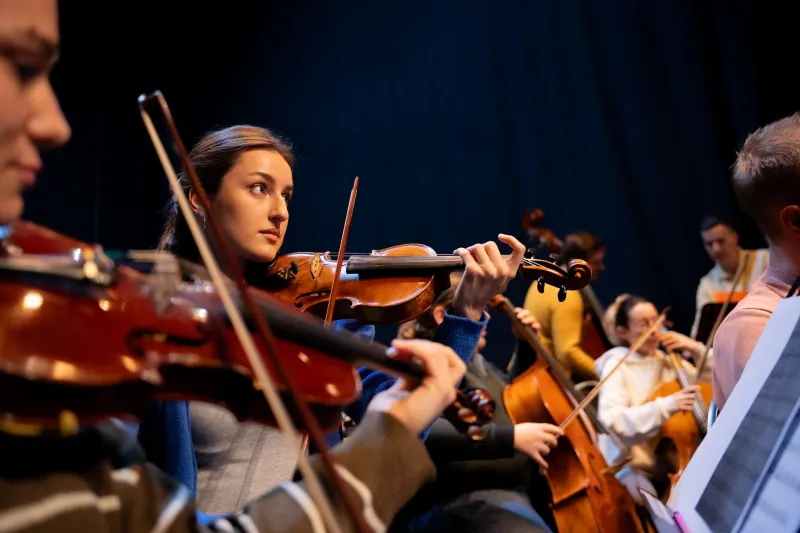
The physical reality of a Broadway pit is, by any measure, humbling. Musicians are pressed together in a space that would make a modest studio apartment seem palatial — stands overlapping, brass instruments angled carefully to avoid collision, string players negotiating elbow room with the quiet diplomacy of seasoned diplomats. The Metropolitan Opera House in New York maintains one of the country's most celebrated orchestral pits, capable of accommodating over one hundred musicians, but the average Broadway house operates with considerably more constraint. Yet within these compressed quarters, something extraordinary unfolds eight times a week.
"People imagine we're down here just following the show," says one veteran Broadway violinist who has performed in more than a dozen long-running productions. "But we're not following anything. We're co-creating it, in real time, every single night." That distinction — between accompaniment and co-creation — is one that pit musicians press with quiet insistence, and it is a distinction well worth examining.
The Conductor's Sovereign Authority
If the pit orchestra constitutes a royal court, then the conductor is its sovereign, presiding over the ensemble from a raised platform at the pit's center. The Broadway music director's role extends far beyond the elegant sweep of a baton. They are the critical interpreter standing between the composer's original score and the living, breathing performance happening above their head. They must track the actors on monitors, anticipate tempo shifts driven by a performer's emotional choices on any given evening, and communicate all of this to twenty or thirty musicians in real time — all while maintaining the musical integrity the show demands.
"No two performances are identical," explains a music director currently overseeing a major national tour. "An actor might take an extra beat for a dramatic pause. A dancer might push the tempo slightly in a particularly charged number. My job is to hold everything together without the audience ever sensing the seams." This improvisational fluency, embedded within a rigorously rehearsed structure, is what distinguishes live theatrical conducting from nearly any other musical discipline.
The preparation alone is staggering. Before a production opens, music directors typically spend months in rehearsal, building a shared vocabulary of cues and signals with their orchestra. They collaborate with directors, choreographers, and sound designers to ensure that the musical landscape serves the larger theatrical vision. By opening night, the conductor has effectively internalized the entire emotional map of the show.
The Technical Demands of an Unseen Art
For the individual musicians in the pit, the technical challenges of live theatrical performance are considerable and distinct from those of concert hall work. A pit musician must read music while monitoring a video feed of the stage, respond to the conductor while remaining attentive to the performers above, and do all of this within a sound environment that is frequently imperfect. Pit acoustics vary dramatically from venue to venue, and the introduction of electronic amplification systems in modern Broadway houses has added new layers of complexity — and occasional frustration — to the equation.
"You're playing in a space that wasn't necessarily designed for the instrument you're holding," notes one woodwind specialist who has worked in pits across New York and major regional houses including Chicago's Lyric Opera and the Ahmanson Theatre in Los Angeles. "You learn to adjust, to listen differently, to trust your colleagues in a way that's almost instinctive."
That trust is perhaps the most defining characteristic of a seasoned pit ensemble. Unlike a symphony orchestra, which rehearses together extensively before each concert program, Broadway pit musicians often rotate in and out of productions, with substitute players — known in the industry as "subs" — stepping in when principal musicians take time off. The ability of a new player to integrate seamlessly into an existing ensemble, often with minimal rehearsal, speaks to a level of professional fluency that borders on the extraordinary.
Regional Theaters: A Different Kind of Kingdom
Beyond the bright corridors of Broadway, regional theaters across the United States maintain their own pit orchestras, and in many cases these ensembles serve as the beating heart of their communities' cultural life. Organizations such as the Goodman Theatre in Chicago, the Alley Theatre in Houston, and the American Repertory Theater in Cambridge have long championed live orchestral accompaniment as a non-negotiable element of theatrical integrity — a stance that carries increasing weight as budget pressures tempt many houses toward recorded music.
The fight to preserve live pit orchestras is, in many respects, a fight for the soul of American theatrical tradition. Audiences may not consciously register the difference between a live ensemble and a recorded track, but they feel it — in the slight variations of tempo that breathe life into a ballad, in the responsive swell of strings that follows an actor's unexpected interpretive choice, in the irreplaceable electricity of human beings making music together in real time.
"A recording can't hear the show," says one longtime pit cellist with characteristic directness. "We can."
Demanding Recognition for a Hidden Reign
In recent seasons, there has been a growing movement within the theatrical community to bring pit musicians into greater public visibility. Some productions have experimented with partially exposed pits, allowing audiences glimpses of the ensemble at work. Others have incorporated pre-show and post-show moments that spotlight individual musicians. The American Federation of Musicians, which represents Broadway's pit players, has long advocated for improved working conditions and greater acknowledgment of musicians' contributions to a production's success.
Award recognition, too, has begun to shift. While Tony Awards have historically focused on the creative team above the stage, conversations about expanding recognition to include musical direction and orchestration have gained momentum in recent years — a development that pit musicians and their advocates welcome with measured optimism.
The Kingdom Endures
There is something deeply fitting about the fact that theater's most powerful musical force operates in deliberate concealment. The pit orchestra's invisibility is not a diminishment but a kind of supreme confidence — the assurance of artists who know that their work is felt, even when it is not seen. Every soaring finale, every heartbreaking reprise, every comedic sting that lands with perfect precision is their gift to an audience that will applaud the performers standing in the light.
At Tsar Folies, we believe that true grandeur demands recognition of all its architects. The musicians who reign below the stage deserve not merely appreciation, but genuine reverence. Their kingdom may be hidden, but its power shapes everything we love about the theatrical experience. The crown, it turns out, has always belonged to them.