Fabric and Fortune: The Visionary Costume Designers Dressing Broadway's Modern Monarchs
There is a particular kind of silence that falls over an audience the moment a breathtaking costume enters the light. It is not the silence of disengagement — it is the silence of awe. On Broadway, where every production competes for the attention of a city that has seen everything, that silence has become the ultimate currency. And the designers responsible for earning it operate with the precision of jewelers and the ambition of emperors.
Broadway's costume kingdoms are thriving, and the designers who rule them are among the most quietly powerful figures in American theater.
The Atelier Behind the Curtain
Unlike the red carpet, where garments are worn once and photographed from a distance, theatrical costumes must survive eight performances a week, endure quick changes measured in seconds, and hold their visual authority under the unforgiving scrutiny of a live audience seated mere feet from the stage. The demands are, in a word, royal.
Designers such as Ann Roth, Bob Mackie, and a new generation of innovators including Emilio Sosa and Clint Ramos approach their craft with a discipline that rivals haute couture. Their workrooms — often tucked into the less glamorous corridors of Midtown Manhattan — function as laboratories where history, artistry, and engineering intersect. Bolts of silk sit alongside industrial-grade Velcro. Antique reference books share shelves with color-calibrated lighting charts. Nothing in these spaces is accidental.
The creative process begins, almost universally, with research. A production set in the court of a European monarch demands rigorous study of period silhouettes, textile trade routes, and the social semiotics of color. Yet the most celebrated designers resist the temptation of pure reproduction. What they pursue instead is evocation — the emotional truth of an era rendered through a contemporary lens.
History Worn Differently
Consider the challenge of costuming a Broadway production that draws upon, say, the visual language of imperial Russia or the gilded excess of Versailles. A literal recreation would feel like a museum exhibit. What audiences require — and what the finest designers deliver — is something more alchemical: the feeling of that world, distilled into garments that can be read instantly from the back row of the orchestra.
This is where modern material science has become an unexpected collaborator. Thermoplastic fabrics, laser-cut lace, and heat-bonded embellishments now allow designers to achieve visual effects that would have been structurally impossible in the eras they reference. A corset that appears to be constructed from eighteenth-century whalebone might, in reality, be supported by a lightweight polymer skeleton. A cape that seems to cascade with the weight of velvet may be engineered from a far lighter synthetic to allow a performer the freedom of movement their choreography demands.
The result is a kind of temporal fiction — garments that honor the past while being entirely of the present.
Dressing Power, Performing Identity
Perhaps the most profound function of theatrical costume is its capacity to externalize interior states. A character's arc, their status, their vulnerability — all of it can be encoded in fabric and silhouette before a single line of dialogue is spoken. Audiences absorb this information instinctively, often without recognizing that they are doing so.
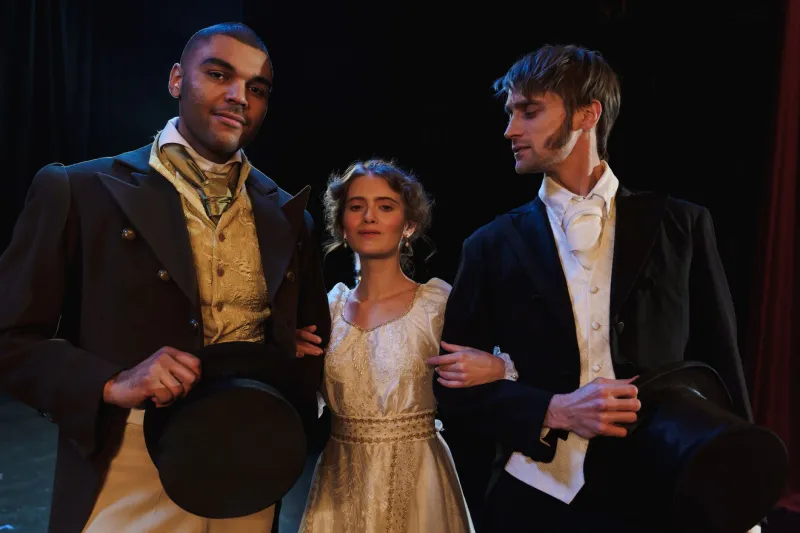
Designers working on productions with complex power dynamics — think the layered hierarchies of a political drama or the shifting alliances within a dynastic musical — must choreograph an entire visual vocabulary across a full cast. Color, texture, and proportion become instruments of storytelling. The monarch's gold must read differently from the courtier's gold. The villain's elegance must carry a subtle menace that distinguishes it from the hero's grandeur.
This kind of visual orchestration requires not only artistic sensibility but an intimate understanding of the production's dramatic architecture — a collaboration with directors and lighting designers that is, at its best, genuinely symbiotic.
From Stage to Street
It would be a mistake to regard Broadway's costume kingdoms as entirely self-contained worlds. Their influence has, with increasing frequency, migrated beyond the theater and into the broader cultural conversation.
Productions such as Hamilton, Hadestown, and & Juliet have generated significant fashion commentary, with their costume designs dissected in publications that have no particular interest in theater per se. The Met Gala, that annual pageant of theatrical self-presentation, has on more than one occasion drawn direct inspiration from Broadway's visual language. Mainstream designers have cited theatrical costuming as a formative influence, and the boundary between stage dressing and fashion design grows more permeable with each season.
This cross-pollination is not incidental. It reflects a broader cultural appetite for the kind of deliberate, narrative-driven dressing that theatrical costume has always practiced. In an era when personal style is increasingly understood as self-authorship, the stage offers a master class.
The Artisans Who Make It Possible
Behind every celebrated designer stands a team of artisans whose contributions rarely receive the recognition they deserve. Drapers, cutters, beaders, and millinery specialists — many of them trained in traditions that stretch back generations — are the hands through which a designer's vision becomes physical reality.
Shops such as Barbara Matera Ltd. and Eric Winterling Inc. have long served as the production houses of Broadway's costume world, employing craftspeople whose skills place them among the finest in any discipline. The knowledge they hold — of how a bias-cut seam behaves under stage lighting, of which dyes hold their saturation through a season of performances — is irreplaceable and, in an industry that perpetually undervalues its own infrastructure, increasingly precious.
The best designers speak of these collaborations with genuine reverence. The garment that earns a standing ovation is never the work of a single imagination; it is the product of a court, assembled in service of a shared vision.
A Kingdom Worth Protecting
As Broadway continues to navigate the economic pressures of a post-pandemic landscape, the budgets allocated to costume design have in some cases contracted. Yet audience expectations have not diminished — if anything, they have intensified, sharpened by years of streaming content and an ever-expanding visual culture that has raised the bar for spectacle at every level.
The designers who meet this moment are those who have mastered the art of doing more with precision rather than simply more with volume. A single, perfectly constructed garment worn by a performer at the center of the stage can carry more visual weight than a dozen middling ones. In this sense, the costume kingdom is not merely a metaphor — it is a genuine realm of expertise, influence, and artistry that Broadway, and American culture at large, would be considerably poorer without.
The performers who wear these creations are, in the most literal sense, crowned by them. And the designers who do the crowning deserve their own moment in the light.